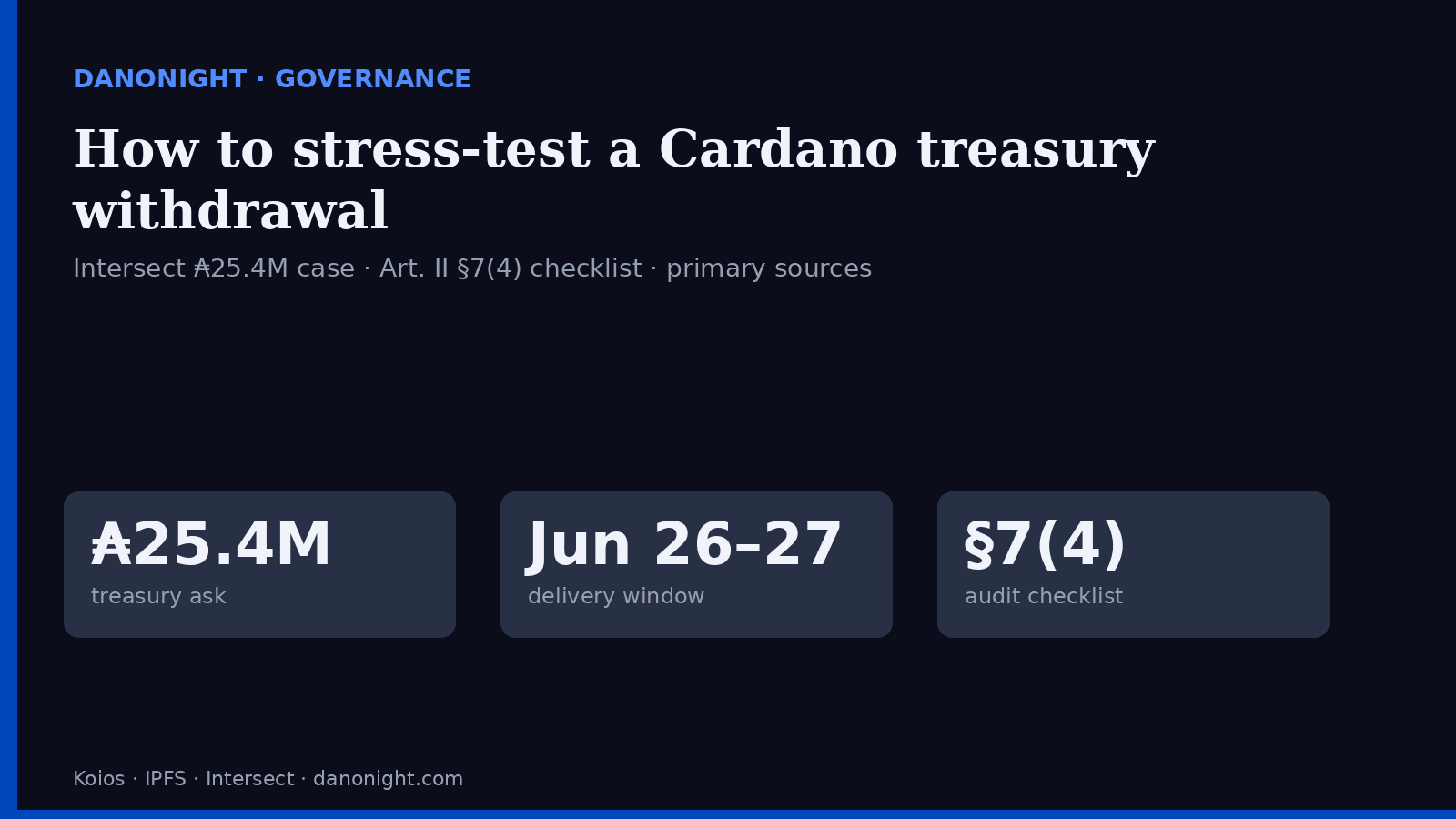
How to stress-test a Cardano treasury withdrawal in 2026 (Intersect ₳25.4M case)
A friendly, primary-source checklist for reading any Cardano Treasury Withdrawal — using Intersect’s ₳25.4M governance-coordination and technical-stewardship ask (June 2026–June 2027) as a live case.
Cardano’s on-chain treasury is not a black box. When someone asks for a large withdrawal, the chain publishes a governance action you can open, read, and stress-test yourself.
This piece is a reader’s checklist for any Treasury Withdrawal in 2026. We walk it with a live case: Intersect’s request for ₳25,400,000 to fund governance coordination and technical stewardship from June 2026 to June 2027.
It is not financial advice and not a YES/NO campaign. The goal is simple: help any ADA holder, DRep, or curious builder know what to open and what questions to ask before they form a view.
---
Why this case (and not the last one you already read)
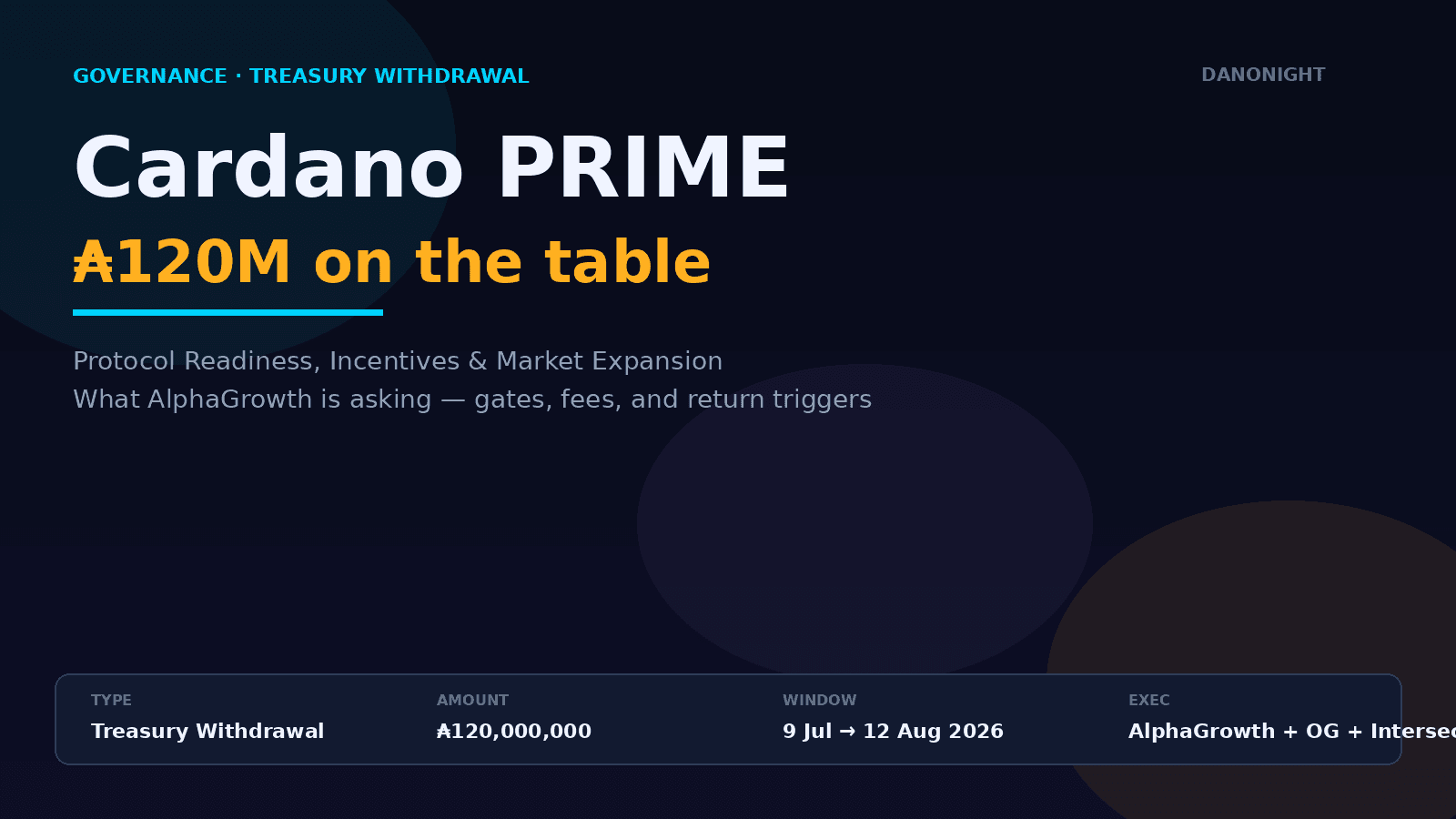
In mid-July 2026 the timeline is busy. PRIME (AlphaGrowth, ₳120M) is a different action with different gates and fee design. Hard-fork parameter votes are yet another family of proposals. This article stays on Intersect’s own operating package — a smaller ask, a different job description, and a debate that often turns on constitutional form: audits, delivery window, refunds, and on-chain custody.
There is also a sibling action for the Technical Steering Committee (TSC) support line (₳1,193,000). We flag it below; the checklist focuses on the main ₳25.4M package.
---
The action at a glance
| Field | Value (primary sources) |
|---|---|
| Title | Withdraw 25,400,000 ada for Intersect: Governance coordination and technical … |
| Type | Treasury Withdrawals |
| Amount | ₳25,400,000 (25,400,000,000,000 lovelace on-chain) |
| Action ID | `gov_action1k02990lhw6wh74t7c6ufw3mqaek9ujtvyan99dj5qv5kvcs7pn8sgx6wlxf` |
| Proposed epoch | 638 |
| Expiration epoch | 645 |
| Period described | June 2026 – June 2027 |
| Proposer framing | Intersect; text sourced from the vendor proposal approved in the Intersect budget process |
| IPFS meta | `ipfs://bafkreibk6uedirxck6snc6lozidgc77gu322rvdn572xjfpt6iyql4qe6i` |
USD in the motivation text: Intersect says the overall ask is more focused than last year — from $7.875M down to $6.35M — while keeping the functions it calls critical for continuity. Treat those dollar figures as proposal planning language, not a live market quote.
On-chain destination (from metadata): rewards to the 2026 Treasury Reserve Smart Contract stake address `stake1784sdxt6jjennmstphgdu7l7c2scf5d02a6cve2dgn5s2kq5u3j9v`, under policy hash `fa24fb305126805cf2164c161d852a0e7330cf988f1fe558cf7d4a64`.
---
What the ₳25.4M is for (in the proposal’s own words)
Abstract (short): fund Intersect for governance coordination and technical stewardship of the Cardano ecosystem.
Motivation (core claim): the package funds Intersect’s core operating model for June 2026–June 2027:
- the Member-Based Organization (MBO) that supports open ecosystem coordination
- reserved capacity for critical unowned processes
- technical stewardship, incident response, and release coordination meant to keep Cardano secure, reliable, and operationally resilient
Intersect also points to work already done: coordinating two network upgrades, preparing a third, and leading ecosystem coordination during the November 2025 chain partition incident.
Budget table in the rationale:
| Work package | ADA |
|---|---|
| WP 1 — Intersect operations and ecosystem coordination | ₳6,000,000 |
| WP 2 — Technical stewardship, incident response & coordination (incl. core Cardano repos) | ₳18,800,000 |
| WP 3 — Management of critical processes | ₳600,000 |
| Total | ₳25,400,000 |
So most of the mass sits in WP2 technical stewardship, not in generic “ops” alone. That matters when you compare this ask to growth/marketing packages (e.g. PRIME): different product, different risk questions.
---
The constitutionality checklist (what to open first)
Cardano’s Constitution sets rules for treasury withdrawals. Community reviewers often start with Article II, Section 7(4) and a short form checklist. The public wording of §7(4) quoted in recent debate is essentially this:
> Treasury Withdrawals actions shall require an allocation of ada as a part of such funding request to cover the cost of periodic independent audits and the implementation of oversight metrics as to the use of such ada.
In practice, careful readers also ask for delivery period and refund conditions — even when those live in neighboring constitutional language or in good proposal hygiene. A practical stress-test looks like this:
#### 1) Audits — is there a real independent assurance path?
What the Intersect rationale says: independent audits and assurance will be provided by [Appold](https://www.appold.com/). The text describes deliverable verification, control testing, spend validation, and milestone evidence where appropriate, next to Intersect’s own milestone-based drawdowns and public disclosures.
What the community is arguing about: does §7(4) require a clear, identifiable allocation to periodic independent audits, or can that cost sit inside a broader budget administration / overhead line?
What Intersect answered publicly (15 Jul 2026, on a related Treasury Withdrawal tranche question): §7(4) requires an allocation covering periodic independent audits and oversight metrics, but does not prescribe separate budget line items. For those proposals, Intersect said the activities are funded inside the Budget Administration component (governance, financial oversight, reporting, and arrangements for independent audit where required). Oversight metrics, they said, live in the Statement of Work, milestone reporting, budget administration, and periodic reporting/audit requirements. They also said future submissions can make this clearer. Source: Intersect on X (replying into the §7(4) thread).
How you can use that as a reader: you are not forced to pick a side in this article. You can mark three boxes:
- [ ] Named independent auditor / assurance provider? (Appold is named for this package.)
- [ ] Can you see how audit/oversight is paid for (dedicated line vs administration bundle)?
- [ ] Are oversight metrics defined in a SoW / milestones you can actually track?
#### 2) Delivery window — when is the work supposed to land?
This package’s motivation is explicit: June 2026 to June 2027. That is a clear 12-month operating year, not an open-ended “as needed” vibe. Flag any proposal that never states a period.
#### 3) Refunds / unspent funds — what returns to the treasury?
The main ₳25.4M rationale emphasizes Sundae Labs treasury management smart contracts, multi-sig style permissions, an Oversight Committee, and a public dashboard — i.e. custody and spend control — more than a single “refund if X” paragraph like some other proposals.
The TSC sibling text is more blunt on leftovers: expenditure fully accounted for and any unspent funds returned to the Cardano treasury (and notes its work packages are contingent on the main Intersect budget’s approval).
Reader move: search the full metadata for unspent, return, sweep, refund, treasury. If the answer is only “we use smart contracts,” ask whether sweep / residual return rules are documented for this instance.
#### 4) On-chain custody — who can move the ADA after a YES?
Intersect states it will use the Sundae Labs budget management framework for 2026 (new instance, same family as 2025):
- TRSC (Treasury Reserve Smart Contract) + one PSSC (Project-Specific Smart Contract)
- Oversight Committee (six external entities named): Sundae Labs, Cardano Foundation, Dquadrant, NMKR, Sundial, Eternl
- High-level multi-party sign-off rules for Fund / Disburse / Pause / Sweep / Reorganize
- Public tracking: treasury.sundae.fi dashboard
- Contract code references: SundaeSwap-finance/treasury-contracts plus TxPipe and MLabs audit PDFs linked from the action metadata
Reader move: a YES on a Treasury Withdrawal is not the same as cashing a blank cheque on day one if the TRSC/PSSC path is real — but you still need to understand who signs disburse and whether the community can watch the UTxOs.
#### 5) Process pedigree — did this pass a prior budget filter?
The rationale says the proposal hit the required 67% support threshold in the 2026 Intersect Budget Process Hydra Voting phase, then advanced to an on-chain Treasury Withdrawal under the approved Budget Process Framework. Metadata links Hydra vote pages, auditor guide, final audited results docs, and an IPFS audit report PDF.
Reader move: off-chain budget support ≠ automatic on-chain YES. It does mean you can ask for the audit of that vote and the vendor proposal history, not only the short abstract on gov explorers.
#### 6) Net Change Limit (NCL) and prior funding
- Intersect claims the ask, alone or in aggregate at submission, does not breach the applicable ₳350M Net Change Limit (epochs 613–713), citing guardrail TREASURY-02a.
- Prior treasury funding disclosure (past 24 months, as listed in the rationale): Intersect + committees ₳22,385,000 total via three listed actions (MBO ₳15.75M, Product Committee ₳0.75M, OSC ₳5.885M).
Reader move: large recurring operators should always show what they already received. Compare scope year-over-year instead of reacting only to the headline number.
---
Vote snapshot (epoch 643 — not final)
From Koios `proposal_voting_summary` for this action, epoch 643:
| Body | Snapshot |
|---|---|
| DRep Yes | 45.32% (61 yes votes cast) |
| DRep No | 54.68% |
| DRep abstain votes cast | 17 |
| Constitutional Committee | 3 yes votes cast · 37.5% yes in the summary fields |
| SPO pool votes in this summary | 0 yes / 0 no cast in the fields returned |
Important: these percentages change by epoch as more votes land. Expiration is still epoch 645. Treat every figure here as a mid-July 2026 snapshot, not a final result.
---
Sibling action (for context only)
| Field | TSC support package |
|---|---|
| Title | Withdraw 1,193,000 ada for Intersect Technical Steering Committee Support |
| Amount | ₳1,193,000 (~$298,250 for 12 months in the motivation text) |
| Action ID | `gov_action1k02990lhw6wh74t7c6ufw3mqaek9ujtvyan99dj5qv5kvcs7pn8sxypfkyr` |
| Note in motivation | Execution contingent on the main Intersect MBO budget’s approval; unspent funds returned to treasury |
Same proposed/expiration epoch band (638 / 645). Useful if you are mapping the full Intersect stack, not a second long-form topic.
---
A 10-minute reading routine you can reuse on any withdrawal
- Identify the action — type `TreasuryWithdrawals`, amount in lovelace, action ID, proposed/expiration epochs.
- Read abstract → motivation → rationale in that order (marketing first, controls later).
- Run the §7(4) checklist — independent audits, oversight metrics, how they are funded.
- Find the delivery period and any refund / unspent language.
- Map custody — who holds funds, multi-sig / smart-contract rules, public dashboard.
- Check process pedigree — budget vote, audits of that vote, prior treasury hauls.
- Check NCL / guardrails as claimed; verify against explorer links when provided.
- Look at a vote snapshot with the epoch label; never treat it as final until the action expires or is enacted.
- Separate families of proposals — operations vs growth incentives vs hard-fork parameters. Different risk questions.
- Decide only after sources — gov explorers, Koios/metadata, IPFS, official proposer posts — not only quote-tweets.
---
Primary links
- Action ID (main): `gov_action1k02990lhw6wh74t7c6ufw3mqaek9ujtvyan99dj5qv5kvcs7pn8sgx6wlxf`
- IPFS metadata: `ipfs://bafkreibk6uedirxck6snc6lozidgc77gu322rvdn572xjfpt6iyql4qe6i`
- Sundae treasury dashboard (linked in rationale): treasury.sundae.fi budget page
- Smart contract repo (linked): github.com/SundaeSwap-finance/treasury-contracts
- Intersect on §7(4) line-item debate: x.com/IntersectMBO/status/2077378776707530957
- Community §7(4) prompt: x.com/yojoflo/status/2077343282347278507
- Community constitutionality review thread (broader batch): x.com/phillewisit/status/2077692029912449203
- Vote API used for the snapshot: Koios `proposal_voting_summary` (epoch 643)
If gov.tools search is slow or incomplete on your side, paste the full action ID into explorers that accept CIP-1694 bech32 action IDs, or pull the same object from Koios `proposal_list`.
---
Bottom line
₳25.4M is not “another PRIME.” It is Intersect asking the treasury to fund a year of coordination + technical stewardship, with most of the mass in incident response, releases, and core repo coordination, under Sundae-managed contracts, named external assurance (Appold), and a live debate about how clearly Article II §7(4) is satisfied when audit costs sit inside administration rather than a dedicated line.
Use the checklist on this package — then reuse it on the next one. That habit is more valuable than any single headline number.
Not financial advice. On-chain governance moves; re-check epochs, votes, and metadata before you act.