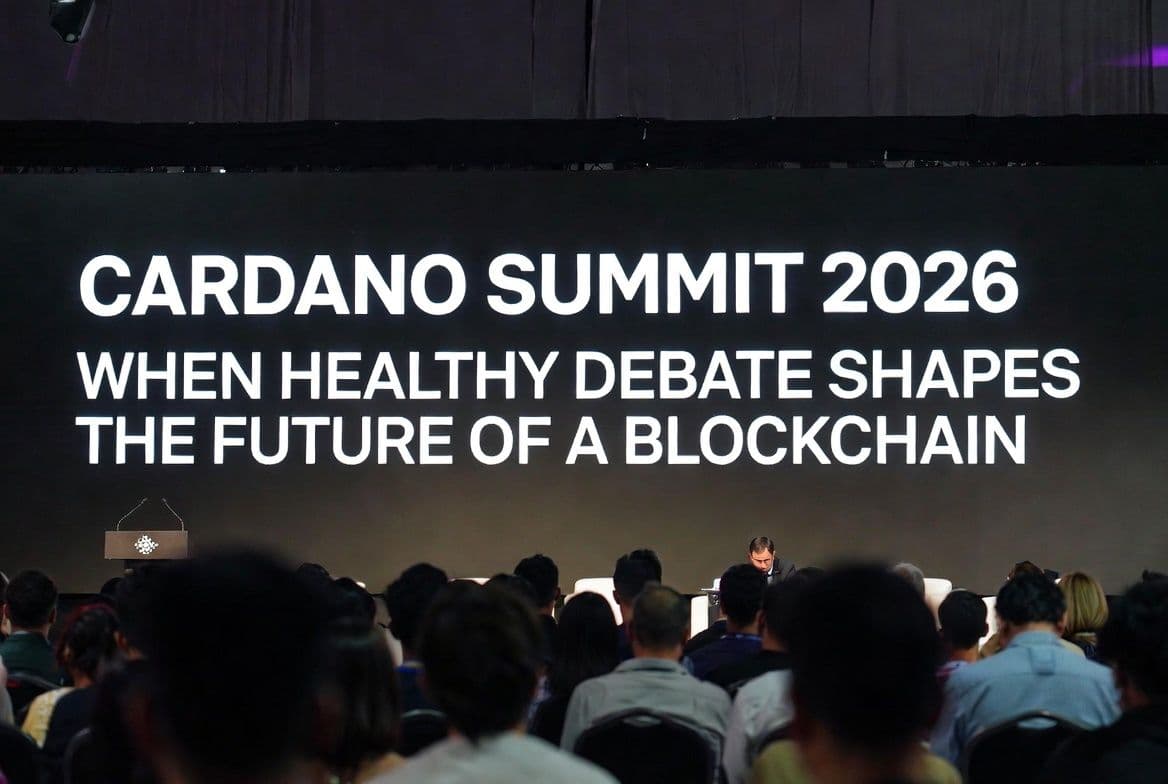
Cardano Summit 2026: When Healthy Debate Shapes the Future of a Blockchain
14 million ADA, one governance vote, and a fundamental question: should Cardano invest in a flagship global event or in permanent infrastructure hubs? The debate between Hoskinson and the Cardano Foundation is not a crisis — it's proof that decentralized governance actually works.
In the world of crypto, most debates unfold on social media — noise, speculation, and tribalism. What is happening right now in Cardano is something different: a structured, on-chain governance debate over how to allocate 14 million ADA from the community treasury. And at the center of it, two visions with the same goal but very different strategies.
The Proposal: Cardano Summit 2026 in Singapore
The Cardano Foundation, together with EMURGO, submitted a treasury proposal requesting 14 million ADA to fund two initiatives: organizing the Cardano Summit 2026 in Singapore (October 5–8) and acting as Title Sponsor at Token2049, one of the most important blockchain conferences in the world.
The strategic logic behind the proposal is clear. Singapore sits at the heart of the Asia-Pacific blockchain ecosystem — one of the fastest-growing markets in the sector. A flagship Cardano event in this city would offer global visibility, direct access to institutional players, developers from emerging markets, and the kind of networking that accelerates real-world adoption. Token2049 alone attracts tens of thousands of professionals from across the industry every year.
The Foundation has responded to community questions with detailed transparency, publishing a comprehensive FAQ that addresses budget breakdown, expected outcomes, and how success will be measured. Their position: major events are not just marketing expenses — they are catalysts for partnerships, developer recruitment, and institutional adoption.
Hoskinson's Counter-Vision: Permanent Hubs Over One-Time Events
Charles Hoskinson, Cardano's founder, moved quickly to offer an alternative vision. Rather than concentrating resources on a single event, he proposed redirecting the 14 million ADA toward building a global network of permanent infrastructure hubs — following the successful model of the Buenos Aires hub that IOG established in Argentina.
Hoskinson's argument is rooted in long-term thinking. A summit lasts four days. A hub lasts for years. Permanent hubs would offer continuous education programs for developers and entrepreneurs, technical support for local projects building on Cardano, a sustained physical presence in multiple regions simultaneously, and a compounding return on investment that a one-time event simply cannot match. The Buenos Aires hub has already proven the model: it has trained hundreds of developers, supported local startups, and created a Cardano community with deep roots in the region.
What the Community Is Saying
The governance vote has activated the community in a way that few proposals do. DReps and ADA holders are expressing genuine opinions — not just on-chain but in forums, on X, and in community calls. The split reflects two legitimate schools of thought.
Those in favor of the Summit argue that brand visibility is an underrated asset in crypto. Cardano has world-class technology but has historically struggled to compete on narrative and mainstream presence. A high-profile event in Singapore, amplified by Token2049 sponsorship, could shift that narrative. Developers choose ecosystems partly based on perceived momentum — and a packed Cardano Summit sends a powerful signal.
Those favoring permanent hubs point to a different kind of ROI. Treasury funds are finite. Infrastructure compounds. The argument goes: instead of one event that produces short-term buzz, invest in structures that generate developers, projects, and adoption for the next five years. Asia is important — but so are Latin America, Africa, and Southeast Europe. Hubs can reach all of them simultaneously.
Why This Debate Is a Strength, Not a Weakness
It would be easy to frame this as internal conflict — Hoskinson vs. the Foundation, old guard vs. institutional forces. But that framing misses the point entirely. What is actually happening is exactly what Voltaire governance was designed to enable: real stakeholders debating real trade-offs with real money on the line, and deciding the outcome through on-chain voting.
No other major blockchain has this level of transparent, structured governance debate. No private boardroom is deciding this. No VC fund is pulling strings. The people holding ADA — from small holders to large DReps — are the ones with the vote. That is remarkable.
The Foundation has committed to respecting the outcome regardless of the result. Hoskinson has made his case and stepped back. The community deliberates. That is Voltaire working as intended.
The Broader Context: Cardano Is Moving on Multiple Fronts
While this debate captures community attention, Cardano is advancing on several other significant fronts in parallel. The Protocol 11 hard fork is in preparation, bringing further performance and governance improvements. Midnight — the privacy-focused sidechain — launched its mainnet in March 2026 and is building its own ecosystem. The $80M Orion fund, a partnership with Draper Dragon, is deploying capital into Cardano-native projects. And on-chain data continues to show strong accumulation by large holders, even against broader market uncertainty.
The Summit debate, in other words, is not happening in a vacuum. It is one decision among many in a protocol that is actively building, shipping, and governing simultaneously. The vote closes around May 9, 2026.
What Should You Do?
If you hold ADA, this vote is yours. You can delegate your voting power to a DRep who represents your values, or — if you have 500 ADA or more — register as a DRep and vote directly. This is the governance system Cardano has been building toward for years. Use it.
Whether Cardano ends up in Singapore in October or funds five new hubs across the globe, the real winner of this process is already determined: a community that debates ideas with conviction, votes with its stake, and builds something designed to last. That is what Cardano is. Disclaimer: this article is informational only and does not constitute financial advice.